
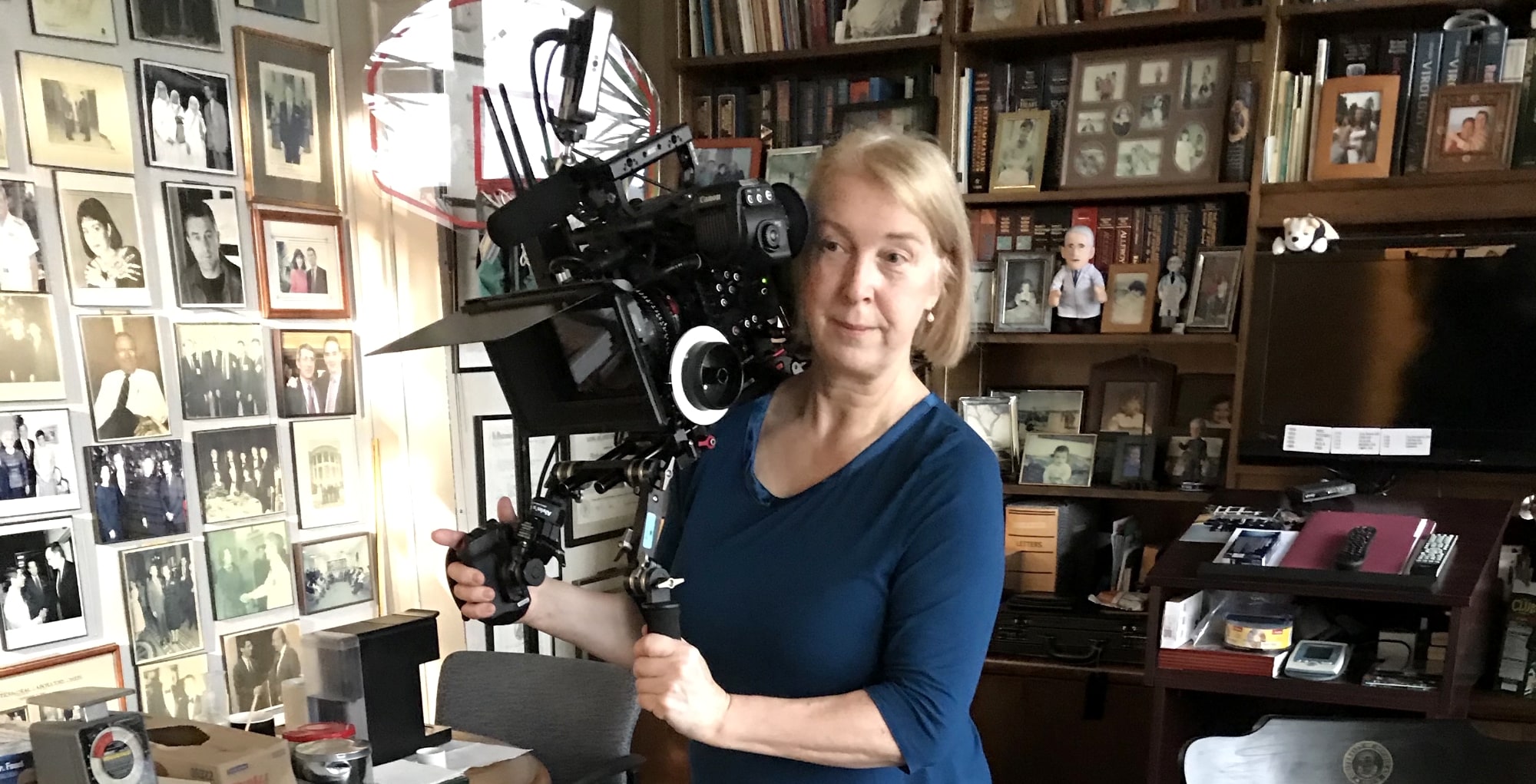
DP Claudia Raschke on set of Fauci. Photo by Zach Wood
Claudia Raschke on Fauci
By Jon Fauer, Film and Digital Times
Fauci is a National Geographic Documentary Film about the life of Dr. Anthony Fauci, the world-renowned infectious disease specialist, physician and public health official. He has been at the forefront of every pandemic from AIDS to COVID-19. Fauci streams on Disney+.
Claudia Raschke grew near Hamburg, Germany. She was interested in art and dance and watched a lot of movies because her mother owned a chain of cinemas. In 1983, Claudia enrolled in the Martha Graham school of dance and studied art and cinematography at NYU. She started working as a 2nd AC for Jost Vacano, BVK, ASC and Stefan Czapsky, ASC. She worked as a DP on features and then moved into award-winning documentaries.
Jon Fauer: What was the impetus for doing the film “Fauci?”
Claudia Raschke: The co-director, John Hoffman, approached me and said, “You did RBG. We want to make a documentary about Dr. Fauci, who has been the longest serving public servant in government, 50 years on the job, seven presidents, innumerable congressional testimonies.” We wanted to shed light on this amazing man. Not many people knew about him at the time. And then COVID happened. All of a sudden, he became a household name. To this day, he is on the news almost every day. He gives us all great guidance during a very difficult time. Our initial approach was to understand this incredible public servant. And then, as we looked at archival footage, we saw that he was a man whose character was forged by the HIV crisis, and now he was being tested again by the COVID pandemic.
I am very grateful that I had the opportunity to meet him. He was very different from RBG, Ruth Bader Ginsburg, who was much more standoffish. It took time for her to warm up to me, but it was because she was dearly afraid of cameras and lights.
I don’t know what her experiences were prior, but when she saw the camera, she would say, “Oh, there’s a camera person.” She would close up. She felt vulnerable. Whereas Dr. Fauci was so approachable. But because of COVID, there was also, “Okay, six feet away, girl, you stand over there.” He would give me this look, and it reminded me very much of RBG who would also shoot me this look of, “You are too close.”
When did filming begin?
It actually began earlier. Janet Tobias, the other co-director, had already started filming Dr. Fauci for a different project in 2018. At that time, she said to him, “Nobody has ever made a portrait film on you. We really should do that.” And then, magically, John Hoffman, who had worked with Dr. Fauci on Weight of the Nation and other projects, also wanted to make the film, so they combined forces together. John and I had worked together on several films, including Weight of the Nation. John was planning to use a lot of archival footage and interviews, some of them maybe stylized. To create an intimate sense of Dr. Fauci, while presenting him in the truest possible way—rather than being an active camera—we took a truly unobtrusive point of view.
What do you mean by stylized interviews?
Sometimes you go to a place and embrace what that location is all about. You find a beautiful angle that is suitable for your character. Hopefully the background emulates something that the character also is talking about, or brings to the conversation. When you stylize something, you might try to shadow the light in certain parts of the scene so it doesn’t interfere with the story.
Stylized, for the directors, was the way to avoid distracting from who Dr. Fauci is. As John once asked me, “Do you think we can just have a black void background for everybody else except for the core family?” We talked about that. Of course, my concern was how to work in a way that felt cohesive throughout the entire film.
The lighting in Dr. Fauci’s office was beautiful. Was it natural light? You had nice shafts of light on the background.
We shot with two cameras side by side to provide more coverage. We had 135 mm and 50 mm Canon CN-E Cinema Primes. To achieve shallow depth of field, we shot at T2.2.
As for lighting, when I first walked into Dr. Fauci’s office, I thought, “Oh my goodness, this is cramped and cluttered full of things. Where am I going to set up the equipment? And there is a huge window that makes our lighting susceptible to the weather conditions.” John said, “Look, we are limited in time when we’re interviewing him, because he’s extremely busy. And now during COVID, he’s even more busy and that’s his priority. If we are allowed and permitted to sit him down, it’ll be maybe for 60 minutes at a time. But because it’s about his entire life, we need multiple sessions, so I need you to come up with a plan that we can repeat over and over again to look like one continuous interview with identical lighting.”

Photo by Visko Hatfield
And then John said, “I love this wall.” That’s the wall with multiple, reflective, award plaques. But, when you are shooting against a wall, there is no depth. He was basically seven and a half feet from the camera, and he was about three feet in front of the wall. Our filming area was 10 feet by 10 feet for two cameras, sound and lighting.
And you had his giant plant in there as well.
We had that giant plant and his table. We tried to move everything out and that was quite a process. I mean, his office is like a museum. It is testimony to all of his achievements: the medals that he has been given, prizes he has won and how he has been recognized. I moved all of those things in order to black out the window and temporarily turn the office into more controllable filming space.
Yes. After blacking out the windows completely and moving whatever we could, John and I decided what was to keep in shot. I did the math of how much room I needed for my lighting, how to arm the fixtures out on booms, and make it all happen.
What kind of lights were they?
LED lights. The main key light was an ARRI SkyPanel 60 with a shallow Chimera Lightbank and a 4’x4′ frame of 250 diffusion.
You had several layers of diffusion?
Yes. The SkyPanel 60 already has a diffusion glass panel that you slide in, and the Chimera gives you a second layer of diffusion. And then we added a 250 frame which was the third diffusion layer. That knocked the light level down as well. But soft lights spread light all over the place. We added 4×4 solid floppies left and right of the source to cut spill light off the walls, and added a 72″x 24″ floppy solid meat axe flag to reduce the bounce off the ceilings. In addition, we added Duvetyn below the 4×4 frame and the single net to slow down the light on Dr. Fauci’s shirt. It was a giant sculpture, but really, it was essentially a single source.
How you got the shafts of light on the background?
The background light was a Source 4 Leko 500W with a 50-degree lens dimmed down to warm the color temperature coming through the open office door. One of my favorite Rosco Gobo abstract patterns emulates afternoon rays of sun coming through at an angle. It was in tune with the idea of Dr. Fauci reflecting on his life.
I liked how you took great care in your lighting. It was not what might be called documentary style or grab and run lighting. Yours was carefully done and it looked beautiful. So, shall we talk about cameras and lenses next?
I used my trusted and true Canon Cinema Primes. I used them on RBG as well. For filtration, I used Schneider Hollywood Black Magic. With the super sharp Canon lenses and cameras with Full Frame, high resolution sensors, I just wanted to take care of softening some of the details, especially the wrinkles.
Which cameras were they?
We had Canon EOS C500 Mark II cameras, recording in Canon Log 2, Cinema Gamut, 4K, Full frame, 2.35:1 aspect ratio. Having that 5.9K Full Frame sensor was adding extra resolution and fabulous to work with.
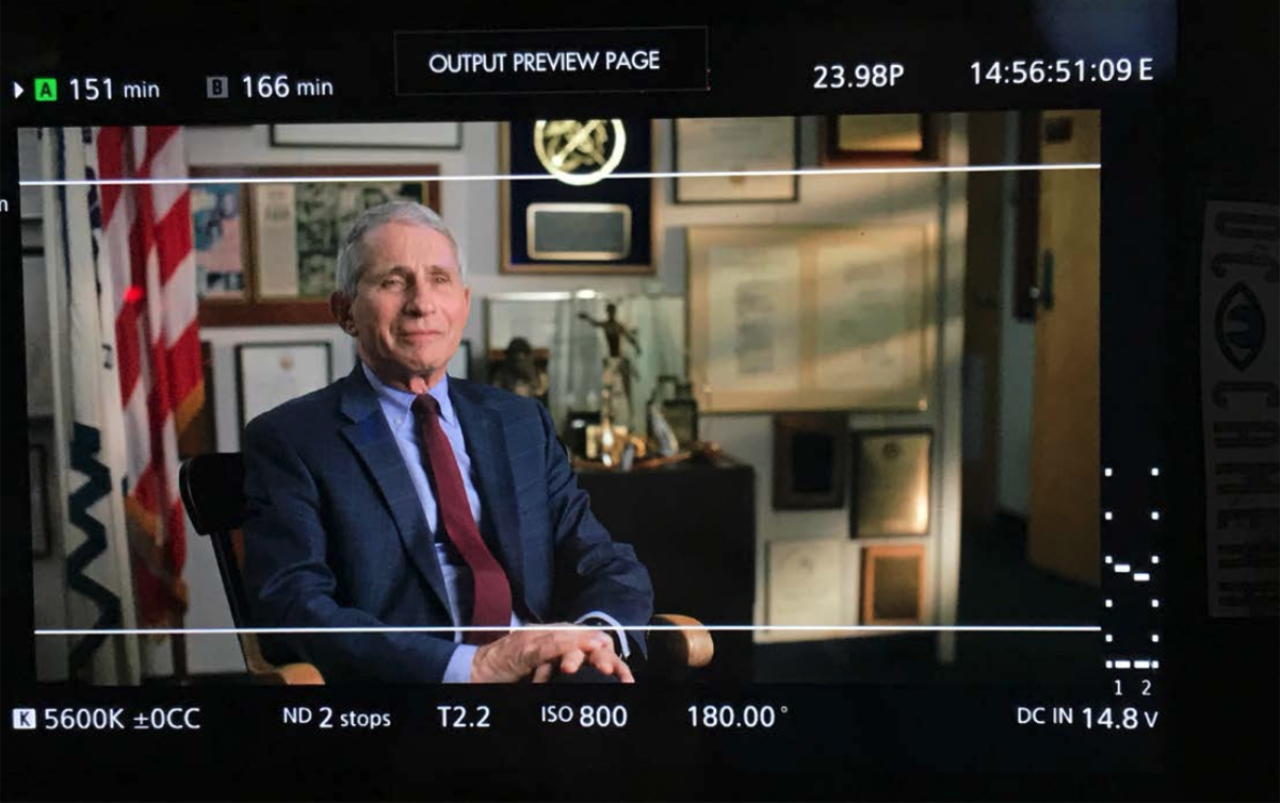
Claudia Raschke on Canon EOS C500 Mark II
A rhetorical question: why did you decide to go Full Frame?
It is an interesting question, because we had that debate. When you shoot Full Frame, and in a 2.35:1 aspect ratio, that tells me it is going into theaters, hopefully around the world. Obviously, the third wave of COVID radically changed that idea and we only had a very limited theatrical run. But with that in mind, you want to have the best dynamic range, the best resolution. So having a Full Frame sensor was a delight for me. It’s like a new canvas to paint on.
I like your canvas analogy. Did you find that Full Frame gave you greater perspective and separation from the background?
I find that Full Frame emulates our perception better. And that’s also why I felt shooting in 2.35:1 was appropriate. Although we are all used to seeing interviews in 16:9, having the widescreen format gives you a different perspective. I wanted the audience to feel the way we did in the presence of Dr. Fauci.
Shooting pretty much wide open, did you have a focus puller?
No focus puller. We didn’t have any room, and COVID restricted who was allowed in the room—only two crew members at a time. We were not even allowed to have the sound person in the room.
You did your own focus?
Yes. I was incredibly grateful for having a camera with such advanced focus technology. I could not use auto focus with the prime lenses, but I relied on the DAF (Dual Pixel Auto Focus) sensor technology for camera’s face detection and the focus guides. DAF can recognize whether or not you are in focus, but also in which direction (near or far) and by how much you’re off. Nailing focus in Full Frame is critical and more complicated than ever. Canon’s dual pixel CMOS sensor has a precise focus intelligence when used in face detect mode then you’re able to easily track somebody in cinéma vérité.
For example, if they turn away or become obscured, the DAF tracking doesn’t hunt for something else. Once your subject turns back around, you’re back on track. Older AF systems would randomly search for something else or be drawn to a high contrast background, therefore leaving the subject in soft focus.
With your manual focus Cinema Primes, focus guides are those two green triangles that point up or down, for near or far, in the viewfinder and come together when you’re in focus?
Exactly. DAF technology informs the green focus guide symbols during face tracking and shows which way the focus is off (near or far indicator at the top or bottom). It is very helpful when I work with Canon primes with manually focus. DAF feeds the information from the lens to the camera via the electronic connections in the lens mount. That way you have a focus tool that gives you instant feedback as your subject moves around but leaves the focus pull in the creative hands of the DP/Operator.
In the interviews, we often were working with a depth of field of three inches. The reason, again, was the desire to not have the background compete with the face. At 3.5 feet away, the background doesn’t completely soften unless you shoot wide open. But wide open at T1.5, I wouldn’t be able to track him. I would’ve only had his eye and his eyelashes in focus and an out of focus nose.
For moving shots where he’s walking down the hall near his office, I guess you were handheld?
Yes. The C500, just like the C300, can be reduced to just having the smart grip on the right side. It’s very easy to carry around, supporting it with your left hand underneath, and then grabbing the focus when needed. The smart handle has either your ISO control or the iris control, depending on how you have programmed it. And you can be really compact. The C500 is lighter for me than the C300. So I had no problem downscaling it so quickly from Sachtler Video 20 tripod to handheld mode.
What camera settings did you like?
We shot mostly at 800 ISO for the best dynamic range. But sometimes I needed to adjust my ISO, and it’s easy to bump your ISO for lower lighting conditions. We shot 4K, 422, 10-bit XF-AVC. It’s the same codec as in the C300 Mark III.
When did you start and finish principal photography?
I joined the team around August 2020. We shot for about a year.
Were the logistics difficult?
Getting into Fort Knox might have been easier than entering the NIH (National Institute of Health). We had to be tested, of course. But getting into the NIH with gear meant was like going through border control. You pull up to a big gate, they have multiple security people, dogs that are sniffing. You have to step out of your vehicle, leave everything open, and step into a room where then they take your ID and verify who you are, and that you actually having a permit to enter, otherwise you’ll be turned away. This entire process happened every day.
Well, that’s reassuring. Did your choice of equipment contribute to the style of the film?
I couldn’t have asked for a better camera to work with because of the sensor, the dual pixel technology, the way that you can downscale it, the buttons that are readily available on the camera and the smart handle, and the incredible sharp LCD viewfinder. It’s just a beautiful camera system.
Five years ago, I founded The Kamera Kollekitv in New York with a group of six highly experienced cinematographers who share common ideas about shooting. When you take on a project, sometimes it lingers over years and you might not be available. The Collective provides colleagues we can recommend who have the same sensibility and 20 plus years of experience. In The Kamera Kollekitv, we own our cameras and share our gear with each other. If we have multiple camera shoots and somebody is not using their camera, then we can use each other’s gear. When the C500 came on the market, we had a big debate: are we letting go of our C300 Mark II cameras? Should we upgrade to the Mark III, or should we go for the C500? And after doing some testing, we all decided to move to the C500. I think it was the best move ever.
On your documentaries, do you ever use zooms?
I favor primes, just because of the look. There’s a philosophical question about that. When you’re using a zoom, there’s obviously the practicality of zooming in when you can’t get close enough. I use the Canon Cine-Servo 17-120 T2.95 and it is one of my favorite cine zoom lenses to work with. However, at his point, it does not cover Full Frame. So that was not an option on Fauci.
But, for other films, I always have it as part of my package.
When you’re shooting cinema verité style, sometimes you have barriers. You are limited in terms of access, so you need to be able to punch in for the details that are really relevant to the story. But I choose primes when I have the space. When you want a closeup, you can walk up to somebody, just as members of the audience could step closer to somebody, and then the person you’re photographing would also know that you’re close. It is different when you are using a zoom and you’re just pushing in, and yes, it can be more unobtrusive. But at the same time, it doesn’t have the same psychological translation.
When you are using a prime lens for intimate moments, you are very close to your character, and there is a trust that they want to share their story, and they acknowledge and accept you in that space. I find that is very powerful. That may explain my tendency to use primes for vérité. Also, you have the ability to open up the aperture, especially in low light conditions. And the Canon sensors have proven themselves over and over again in how beautiful the shadow details are and how you can just step into darkness and still see.
Let’s hope Canon lens designers will be reading this interview and they’ll be inspired to make Full Frame cinema zooms.
Yes, I hope so too. That would be my wish.
You mentioned earlier that Dr. Fauci was quite approachable.
He’s not shy and he’s also funny. By the end of filming, we felt very close. I mean, I watched this man cook. It’s one of the scenes that’s not in the film, but I absolutely adored it. It was just an amazing scene of him cooking a very traditional Italian holiday dish. He was cooking penne pasta, and every few seconds he would test one and then he would reset the timer, saying, “Another 30 seconds.” He would stare into the pot and then take his fork and taste again. It was so scientific. I’ve never seen anybody cook so scientifically.
I guess those Jesuit teachers at Regis High School, that he mentions, certainly taught him how to speak well.
He is incredibly articulate, indeed. And he is not judgmental. We tried to pressure him in terms of his political opinion. But he said, “I don’t want to even go there, because what I’m concerned about is the health of the nation and how we can navigate this. Politics have nothing to do with it.”
Politics seemed to be his biggest source of confusion. He said, “I do not understand why there is such aversion to vaccination or such aversion to science, when science is what brought us such help with vaccines for AIDS, Ebola or malaria. Science is so essential.” He seemed very baffled why there was such opposition.
Not just here, but in Europe as well.
It’s everywhere. In the Same Breath is a documentary by Nanfu Wang that goes into this topic.Galileo said, “I do not feel obliged to believe that the same God who has endowed us with sense, reason and intellect has intended us to forgo their use.” Your film on Dr. Fauci, a man with sense, reason and intellect, was powerful and essential.
I’m glad you liked it. Dr. Fauci is an amazing man.